A short video on Psychoanalysis produced by the Institute of Psychoanalysis. If you visit their website there are two other short video's on Psychoanalysis: British Psychoanalysis Yesterday and Today and Training to be a Psychoanalyst.
Link to Institute of Psychoanalysis
Showing posts with label Psychopathology. Show all posts
Showing posts with label Psychopathology. Show all posts


13.2.11
3.1.11
Defining Mental Illness
"Every so often Al Frances says something that seems to surprise even him. Just now, for instance, in the predawn darkness of his comfortable, rambling home in Carmel, California, he has broken off his exercise routine to declare that “there is no definition of a mental disorder. It’s bullshit. I mean, you just can’t define it.” Then an odd, reflective look crosses his face, as if he’s taking in the strangeness of this scene: Allen Frances, lead editor of the fourth edition of the American Psychiatric Association’sDiagnostic and Statistical Manual of Mental Disorders (universally known as the DSM-IV), the guy who wrote the book on mental illness, confessing that “these concepts are virtually impossible to define precisely with bright lines at the boundaries.” For the first time in two days, the conversation comes to an awkward halt".
Link to an article in Wired on the problem of defining and diagnosing mental disorders and conflicts between psychiatrists over the new edition of the Diagnostic and Statistical Manual of Mental disorders: Inside the Battle to Define Mental Illness
18.10.10
Biological Therapies
A short but clear animation of what Selective Serotonin Reuptake Inhibitors do. This is also a very clear explanation of one major biological explanation of depression: the serotonin hypothesis.
You can see it here...
You can see it here...
13.6.10
10.6.10

9.6.10
Diagnosis

Scizophrenic or psychotic depression? Phobic or obsessive compulsive? How about a personality disorder? The Wall Street journal has an article on how film characters are being used to train psychiatrists to diagnose mental disorders using checklist systems like DSM IV. Why not have a go yourself and use the signs and symptoms checklists in DSM IV to complete the diagnosis of the following film characters.....
Link to: Fictional stars, real problems
Link to: See a shrink

4.4.10
Biological treatments: Drugs
Before 1952 biological treatments for mental disorders were limited. In 1952 a French surgeon discovered by accident the first drug treatment for serious mental disorders: chloropromazine.


This site has a cartoon strip that describes the discovery of the first drug treatment for serious mental disorders.
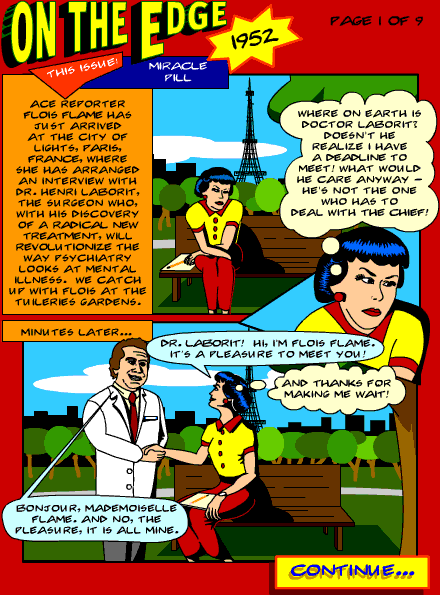

This site has a cartoon strip that describes the discovery of the first drug treatment for serious mental disorders.
ECT
The Folens on-line companion has a post on Daryl Cunningham's new comic strip book 'Psychiatric Tales'. The story below is all about one biological treatment: ECT. It's well worth reading: Daryl Cunningham really knows what he is talking about.


More here...
20.3.10
Depression: Nature v Nurture
"The debate whether it’s nature or nurture that dictates your life has raged since the time of Darwin. But the latest DNA testing and our understanding of genetic action, is sending us into a new era.
Jonica Newby steps into the future by taking a DNA test not yet available to the public. The test will reveal whether she has the double gene for depression. If she does, science says she will be prone to severe depression during stressful times.
The story captures the moment when the news is delivered and discusses the implications of knowing your genetic destiny.
The link between genes and behaviour is being closely studied in Dunedin, New Zealand. Similar attempts over the last 20 years have failed – but this team did something unusual. They cross-referenced the genes with the person’s background – with extraordinary results.
Their first discovery has been hailed as a gene for violence. We explain how it works – people who have one version of the MAOA gene are not readily able to damp down their stress response in the brain. But it’s only a problem if they have a stressful childhood – most people with the wrong gene/environment combination have ended up in jail for violent crime.
And now, the same team has found a gene for depression. It involves a different neurotransmitter – in this case using the serotonin system – but the same applies; combine a certain gene with stressful life events, and these people are far more likely to develop depression.
The debate between nature and nurture may soon be declared a tie.
Combine the two and it seems you may have a powerful predictor of human behaviour. The discovery will change society forever from our legal system, to healthcare and insurance and even perhaps what it means to be human".
Click the link under the headline Nature Nurture to launch a 10 min ABC documentary on nature v nurture in aggression and depression.
Jonica Newby steps into the future by taking a DNA test not yet available to the public. The test will reveal whether she has the double gene for depression. If she does, science says she will be prone to severe depression during stressful times.
The story captures the moment when the news is delivered and discusses the implications of knowing your genetic destiny.
The link between genes and behaviour is being closely studied in Dunedin, New Zealand. Similar attempts over the last 20 years have failed – but this team did something unusual. They cross-referenced the genes with the person’s background – with extraordinary results.
Their first discovery has been hailed as a gene for violence. We explain how it works – people who have one version of the MAOA gene are not readily able to damp down their stress response in the brain. But it’s only a problem if they have a stressful childhood – most people with the wrong gene/environment combination have ended up in jail for violent crime.
And now, the same team has found a gene for depression. It involves a different neurotransmitter – in this case using the serotonin system – but the same applies; combine a certain gene with stressful life events, and these people are far more likely to develop depression.
The debate between nature and nurture may soon be declared a tie.
Combine the two and it seems you may have a powerful predictor of human behaviour. The discovery will change society forever from our legal system, to healthcare and insurance and even perhaps what it means to be human".
Click the link under the headline Nature Nurture to launch a 10 min ABC documentary on nature v nurture in aggression and depression.
17.3.10
Dentist Phobia

"A girl who starved to death after having eight teeth removed had a deep fear of dentists which went unnoticed by authorities, a coroner has said".
Read more here...
Answer the following questions:
'Describe how the cognitive approach to psychopathology would explain the girls fear of dentists'. (6 marks)
'Outline how a cognitive behavioural therapist would use REBT to help the girl with her fear of dentists'. (6 marks)
16.3.10
DSM-V

The image above shows how the number of mental disorders have expanded with each new publication of the American Diagnostic and Statistical Manual of Mental disorders. This has led some psychiatrists to claim that ordinary states of mind, feelings, and some behaviours have become pathologised.
A new version of the DSM is being produced right now and many psychiatrists and psychologists are concerned that 'normal' states of mind and some 'normal' behaviours will be classified as disordered or abnormal and require treatment:
"Three changes, in particular, could lead to an enormous pathologization of non-disordered conditions. The first is the suggested revision of the criteria for Major Depressive Episode to remove the bereavement exclusion from this diagnosis. At present, the criteria for major depression require five or more out of nine symptoms including sadness or lack of interest or pleasure that least for at least two weeks. However, the criteria exclude people who experience these symptoms in response to bereavement: “The symptoms are not better accounted for by Bereavement” That is, people who develop enough symptoms to meet the criteria after the death of an intimate are nevertheless not defined as disordered but instead as suffering from a natural, nondisordered response to loss".
Link to DSM-V: Getting Closer to Pathologising everyone
Link to DSM-IV-TR
Link to DSM-V Development
14.3.10
Depression's upside

"For Darwin, depression was a clarifying force, focusing the mind on its most essential problems. In his autobiography, he speculated on the purpose of such misery; his evolutionary theory was shadowed by his own life story. “Pain or suffering of any kind,” he wrote, “if long continued, causes depression and lessens the power of action, yet it is well adapted to make a creature guard itself against any great or sudden evil.” And so sorrow was explained away, because pleasure was not enough. Sometimes, Darwin wrote, it is the sadness that informs as it “leads an animal to pursue that course of action which is most beneficial.” The darkness was a kind of light".
How evolutionary theory might explain depression: Depression's Upside
Lancelot Link and The Evolution Revolution
Lancelot Link Roll In the clover
Uploaded by Roag3. - Watch hilarious animal videos
13.3.10
What is normal?
"What does it mean to be normal? And abnormal? Who gets to decide, and what are the repercussions? When do we applaud deviations from the norm, when do we condemn them, and why? Ken and John take a look at the uses and abuses of making judgments about normality with Charles Scott from Vanderbilt University, author of Living With Indifference".
Link to: Philosophy Talk discussion of what is normal?
Link to: Philosophy Talk radio broadcast 'What is normal?'
Link to: Philosophy Talk discussion of what is normal?
Link to: Philosophy Talk radio broadcast 'What is normal?'
5.3.10
The drugs just don't work...or do they?

Are anti-depressants just expensive Tic-Tacs, no better at treating depression than a placebo? Press reports of recent studies suggest just that: the drugs just don't work. But, as always its a bit more complicated than that. The research actually suggests that the drugs do work but mainly for people with severe depression.
The first link is to a short Scientific-American article that summarises the do they don't they work debate.
The second link is to a longer analysis from Newsweek.
The third link is to an interesting analysis of one of the most recently published studies in the Journal of the American medical association.
What implications does this research have for the biological explanation of depression? What implications does this research have for biological therapies in terms of their effectiveness and appropriateness? Plenty of AO2/AO3 material in these articles. Why not read one and turn it into a short paragraph? Could come in useful for a Unit 4 psychopathology essay in the exam.
4.3.10
Fear of Flying

Marge: [panicked] I think I'll go get a picture of the plane taking off.
[struggles with her seat belt]
Homer: Marge, what's wrong? Are you hungry? Sleepy? Gassy? Is it
gas? It's gas, isn't it?
Marge: Homer, I've never told you this before, but I'm not a good flyer.
[pants, gasps] I have to get off the plane. Let me off the
plane. [stands up] I'm asking you nicely to open the doors!
Homer: Take it easy, Marge. How about if we dope you up real good?
Marge: [screaming] Let me off let me off let me off let me off let me
off let me off -- [runs up and down the aisle]
[the plane takes off as the family watches]
Homer: It's OK, Marge. We don't need to go on a trip; we'll just wait
for the killer bees to come to us.
Watch Fear of Flying.
Answer the following question:
Marge is afraid of flying. She goes to see a behavioural psychologist. The psychologist recommends systematic desensitisation as a treatment for her fear of flying.
(a) Marge goes to see a behavioural psychologist. Outline key features of the behavioural approach to psychopathology. (6 marks)
(b) Explain how systematic desensitisation might be carried out to overcome Marge's fear of flying. (6 marks)
3.3.10
24.2.10
O.C.D
Psychfiles has an interview with a student with OCD. It also has links to useful information about OCD and its treatment.
Link to Obsessive Compulsive Disorder-An Interview with Bobbi
Link to Obsessive Compulsive Disorder-An Interview with Bobbi
Subscribe to:
Posts (Atom)


