Showing posts with label AS. Show all posts
Showing posts with label AS. Show all posts
9.9.12
The body's response to stress: part 2
Watch the video and answer the questions below:
1. What is Andys mouth swab showing?
2. What hormones does the Adrenal gland release?
3. What effects do the hormones identified in Q2 have on Andys body?
4. How did the stress response help Andy?
5. What can chronic stress do?
6. What effects did chronic stress have on Judes health?


The body's response to stress: part 1
Watch the video and answer the questions below:
1. What high is Andy seeking?
2. What can Andy feel an hour before the Bull run?
3. Why do you think Andy feels the way he feels before the Bull run?
4. What does the swab measure?
5. What is in the back of Andy's mind?
9.9.11
What is Psychoanalysis?
A short video on Psychoanalysis produced by the Institute of Psychoanalysis. If you visit their website there are two other short video's on Psychoanalysis: British Psychoanalysis Yesterday and Today and Training to be a Psychoanalyst.
Link to Institute of Psychoanalysis
Link to Institute of Psychoanalysis
18.10.10
Biological Therapies
A short but clear animation of what Selective Serotonin Reuptake Inhibitors do. This is also a very clear explanation of one major biological explanation of depression: the serotonin hypothesis.
You can see it here...
You can see it here...
12.10.10
26.9.10
7.8.10
2.8.10
Under Pressure

What do Baboon's and Civil Servants have in common? What's the difference between Oscar winning actors and actors who haven't won an Oscar and what links attachment, separation and vulnerability to stress?
Wired Magazine has just published a long but useful article on stress and the impact of chronic stress on human health. It gives a clear explanation of the biology of stress and outlines a range of different studies that have changed our understanding of stress and it's impact on health. It also provides an interesting overview of the scientific process: initial observation, the formulation of a hypothesis, collection of data and the testing of that hypothesis in field experiments, lab experiments, natural experiments and longitudinal studies. Of particular interest is the outline of Michael Marmot's Whitehall study and how the civil service is the human equivalent of a Baboon troop:
"The British civil service comes with one other feature that makes it ideal for studying the health effects of stress: It’s hierarchical, with a precise classification scheme for ranking employees (in other words, it’s the human equivalent of a baboon troop). At the bottom are messengers, porters, and security guards. Just above them are the clerical officers, followed by staff scientists and other professionals. This last group implements the policies dictated by powerful administrators who run the governmental agencies. Marmot wanted to investigate how differences in status “in people who are neither very poor nor very rich” might lead to measurable differences in health".
The article brings stress research bang up to date with Robert Sapolsky's work on a stress vaccine. Sapolsky is developing and testing a gene therapy for the negative effects of stress on the brain by modifying the herpes simplex virus to infect brain cells to protect them against the damaging effects of stress. This is a good example of how psychology is also an applied science: psychological research is not just about finding out interesting things about how the mind works and how it can influence basic biological processes, it's also about developing practical applications that can help people to deal with problems like the negative effects of stress.
Link to Under Pressure: The Search for a Stress Vaccine
24.7.10
The Tenth Level

Mindhacks have found The Tenth Level on youtube: a 1975 American TV film of Milgram and his obedience to authority experiments, starring William Shatner.
Link to The Tenth Level
22.6.10
Stress causes wounds to heal more slowly

Marucha et al (1998) found that exam stress led to a reduction in the speed of wound healing. They concluded that exam stress can have a significant effect on wound healing. Recent research by Weinman at King’s College London suggests that this may be due to increased levels of cortisol. Weinman gave healthy volunteers a standardised questionnaire to measure their level of life stress and then gave each participant an identical punch biopsy wound. The researchers monitored the wound for three weeks and used ultrasound imaging to measure how quickly the wound healed. They found that participants who had a low stress score on the life stress questionnaire healed twice as quickly as participants who had a high stress score. They also measured levels of cortisol and found that the high stress score participants had higher levels of cortisol. More importantly this finding has been replicated and a systematic review of 22 studies investigating stress and wound healing support the link between stress and wound healing.
13.6.10
10.6.10

9.6.10
Diagnosis

Scizophrenic or psychotic depression? Phobic or obsessive compulsive? How about a personality disorder? The Wall Street journal has an article on how film characters are being used to train psychiatrists to diagnose mental disorders using checklist systems like DSM IV. Why not have a go yourself and use the signs and symptoms checklists in DSM IV to complete the diagnosis of the following film characters.....
Link to: Fictional stars, real problems
Link to: See a shrink

4.4.10
Biological treatments: Drugs
Before 1952 biological treatments for mental disorders were limited. In 1952 a French surgeon discovered by accident the first drug treatment for serious mental disorders: chloropromazine.


This site has a cartoon strip that describes the discovery of the first drug treatment for serious mental disorders.
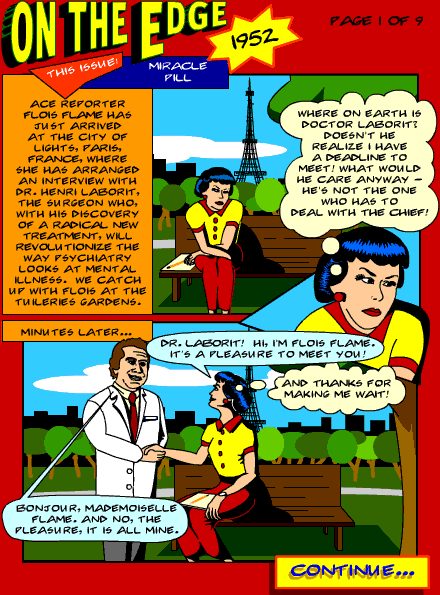

This site has a cartoon strip that describes the discovery of the first drug treatment for serious mental disorders.
Milgram
The BPS Research Digest blog has a really interesting post on Milgram's obedience studies and a link to the full article:
Russell, N. (2010). Milgram's obedience to authority experiments: Origins and early evolution. British Journal of Social Psychology.
Link to Milgram's obedience to authority experiments: Origins and early evolution
Link to Milgram's obedience to authority experiments: Origins and early evolution
ECT
The Folens on-line companion has a post on Daryl Cunningham's new comic strip book 'Psychiatric Tales'. The story below is all about one biological treatment: ECT. It's well worth reading: Daryl Cunningham really knows what he is talking about.


More here...
21.3.10
Subscribe to:
Posts (Atom)


