Showing posts with label Stress. Show all posts
Showing posts with label Stress. Show all posts
9.9.12
The body's response to stress: part 2
Watch the video and answer the questions below:
1. What is Andys mouth swab showing?
2. What hormones does the Adrenal gland release?
3. What effects do the hormones identified in Q2 have on Andys body?
4. How did the stress response help Andy?
5. What can chronic stress do?
6. What effects did chronic stress have on Judes health?


The body's response to stress: part 1
Watch the video and answer the questions below:
1. What high is Andy seeking?
2. What can Andy feel an hour before the Bull run?
3. Why do you think Andy feels the way he feels before the Bull run?
4. What does the swab measure?
5. What is in the back of Andy's mind?
2.8.10
Under Pressure

What do Baboon's and Civil Servants have in common? What's the difference between Oscar winning actors and actors who haven't won an Oscar and what links attachment, separation and vulnerability to stress?
Wired Magazine has just published a long but useful article on stress and the impact of chronic stress on human health. It gives a clear explanation of the biology of stress and outlines a range of different studies that have changed our understanding of stress and it's impact on health. It also provides an interesting overview of the scientific process: initial observation, the formulation of a hypothesis, collection of data and the testing of that hypothesis in field experiments, lab experiments, natural experiments and longitudinal studies. Of particular interest is the outline of Michael Marmot's Whitehall study and how the civil service is the human equivalent of a Baboon troop:
"The British civil service comes with one other feature that makes it ideal for studying the health effects of stress: It’s hierarchical, with a precise classification scheme for ranking employees (in other words, it’s the human equivalent of a baboon troop). At the bottom are messengers, porters, and security guards. Just above them are the clerical officers, followed by staff scientists and other professionals. This last group implements the policies dictated by powerful administrators who run the governmental agencies. Marmot wanted to investigate how differences in status “in people who are neither very poor nor very rich” might lead to measurable differences in health".
The article brings stress research bang up to date with Robert Sapolsky's work on a stress vaccine. Sapolsky is developing and testing a gene therapy for the negative effects of stress on the brain by modifying the herpes simplex virus to infect brain cells to protect them against the damaging effects of stress. This is a good example of how psychology is also an applied science: psychological research is not just about finding out interesting things about how the mind works and how it can influence basic biological processes, it's also about developing practical applications that can help people to deal with problems like the negative effects of stress.
Link to Under Pressure: The Search for a Stress Vaccine
22.6.10
Stress causes wounds to heal more slowly

Marucha et al (1998) found that exam stress led to a reduction in the speed of wound healing. They concluded that exam stress can have a significant effect on wound healing. Recent research by Weinman at King’s College London suggests that this may be due to increased levels of cortisol. Weinman gave healthy volunteers a standardised questionnaire to measure their level of life stress and then gave each participant an identical punch biopsy wound. The researchers monitored the wound for three weeks and used ultrasound imaging to measure how quickly the wound healed. They found that participants who had a low stress score on the life stress questionnaire healed twice as quickly as participants who had a high stress score. They also measured levels of cortisol and found that the high stress score participants had higher levels of cortisol. More importantly this finding has been replicated and a systematic review of 22 studies investigating stress and wound healing support the link between stress and wound healing.
21.3.10
20.3.10
Systematic Desensitisation
"Progressive muscle relaxation [PMR] was first identified by Jacobson in 1934 as tensing and releasing of 16 muscle groups. Wolpe adapted it for use with systematic desensitization in 1948 and Bernstein and Borkovec in 1973 studied adjustments to the technique to fit cognitive behavioral stress management".......read more here...


21.1.10
11.1.09
Type A
Everything you could possibly want to know about Type-A behaviour and it's impact on health. Maybe. Another video from Stanfords youtube channel. Wes Alles, the lecturer, also discusses how Type-A behaviour can be modified and outlines a range of stress reduction methods.
Be warned it's two hours long......
Sapolsky on Stress
I have posted a link to this documentary before. You can find a link to the website here....
This is a short clip from the documentary. Robert Sapolsky outlines the adaptive value of the stress response in our evolutionary past but points out that the modern world is very different and the stress response may now be maladaptive.
This is a short clip from the documentary. Robert Sapolsky outlines the adaptive value of the stress response in our evolutionary past but points out that the modern world is very different and the stress response may now be maladaptive.
29.9.08
Stress: Portrait of a Killer

PBS have just broadcast a documentary on stress presented by Robert Sapolsky. They have a website to accompany the documentary and you can watch video clips, take part in an on-line stress quiz and read about the research methods used by biological psychologists.
The intoduction to the documentary is also pretty useful:
"The stress response: in the beginning it saved our lives, making us run from predators and enabling us to take down prey. Today, human beings are turning on the same life-saving physical reaction to cope with 30-year mortgages, $4 a gallon gasoline, final exams, difficult bosses and even traffic jams — we can't seem to turn it off. So, we're constantly marinating in corrosive hormones triggered by the stress response.
Now, scientists are showing just how measurable — and dangerous — prolonged exposure to stress can be. Stanford University neurobiologist, MacArthur "genius" grant recipient, and renowned author Robert Sapolsky reveals new answers to why and how chronic stress is threatening our lives in Stress: Portrait of a Killer, a National Geographic Special. The hour-long co-production of National Geographic Television and Stanford University was produced exclusively for public television."
Stress: Portrait of a Killer21.8.08
Stress: spots and acne

Do you find that during exams you start to get spots? How about a messy break up? Stressors like exams can activate the 'fight-flight' response and adrenaline and cortisol are released. Cortisol helps to convert stores of energy in the body into a form the body can use. It also helps to reduce pain and speed up healing. All pretty useful if your attacked by a lion and fighting for your life but not so useful if you have to sit still and just write a couple of essays.
Cortisol can cause the skin to release oil. This can then lead to spots and in cases of chronic stress lead to acne and other skin problems.
The first link below is to an article on the effect of stress on the skin. The second link is to a study that investigated the effect of stress on adolescent acne.
19.8.08
Stress: psychogenic dwarfism

Meet Kenadie
The photo above is of Kenadie Jourdin-Bromley. She is a primordial dwarf. This is a very rare genetic condition. You can read more about her here.
Most forms of dwarfism have a genetic cause. But there is one form of dwarfism that is caused by stress: psychogenic dwarfism. When the fight-flight response is activated hormones are released that speed up some physical processes and switch off others. Children that are raised in threatening and stressful environments may stop growing. In this situation the stress expert Robert Saplosky prescribes a parentectomy: if they are taken out of that stressful environment they may start to grow normally.
Relationship stress
Then.....

Now.....

There have been news reports that the T.V. presenter Gail Porter's hair is growing back. In 2005 she split from her husband and attempted suicide. Shortly afterwards she was diagnosed with auto-immune disease alopecia.
The immune system protects people from bacteria, viruses, and toxins. Stress can cause the immune system to malfunction: it may become under-active and fails to defend the body against infection or hyperactive and begins to attack cells in the body. It's possible that a series of stressful life-events triggered Gail Porter's immune system to produce T cells that attacked and destroyed her hair follicles.
Not sure about her dog Missy though, but there is something called Canine follicular dysplasia.
The link below is to a Scientific American article on stress and the research of Janice Kiecolt-Glaser and her partner Ronald Glaiser.
The Danger of Stress

Now.....

There have been news reports that the T.V. presenter Gail Porter's hair is growing back. In 2005 she split from her husband and attempted suicide. Shortly afterwards she was diagnosed with auto-immune disease alopecia.
The immune system protects people from bacteria, viruses, and toxins. Stress can cause the immune system to malfunction: it may become under-active and fails to defend the body against infection or hyperactive and begins to attack cells in the body. It's possible that a series of stressful life-events triggered Gail Porter's immune system to produce T cells that attacked and destroyed her hair follicles.
Not sure about her dog Missy though, but there is something called Canine follicular dysplasia.
The link below is to a Scientific American article on stress and the research of Janice Kiecolt-Glaser and her partner Ronald Glaiser.
The Danger of Stress
22.7.08
Stress

The link below is to an audio lecture by Robert Sapolsky, Professor of neuroscience at Stanford University, and provides an overview of the effect of acute and chronic stress on the body and its impact on the the brain. In this audio lecture he discusses his research investigating the stress response in Baboons. This is a good example of a field experiment using animals.
Robert Sapolsky "Stress and memory: Forget it"

15.7.08
Stress-related illness
The term "stress" was borrowed from engineering by Hans Selye in the 1930's. Selye investigated the biology of the stress response and established a link between stress and a range of stress-related illnesses.
Recent research by Janice Kiecolt-Glaser has focused on the effect of stress on the immune system. This research has established a new area of biological psychology called psychoneuroimmunology.
The link below is to a short radio programme by Vivienne Parry on the biological basis of stress and explains how long term stress (chronic stress) can have a negative effect on the cardiovascular system, the immune system, and the brain. It also includes a good example of the kind of research that biological psychologists conduct using human participants.
Vivienne Parry investigates the biological basis of stress
4.3.07
Stress and Invividual Differences

Robert Sapolsky and friend
This is a video of a lecture by Robert Sapolsky on Stress, Neurodegeneration, and Individual Differences. He is one of the worlds leading experts on stress. He has spent a lot of time observing Baboons as part of his research. Too much time by the look of him. Not much evidence of individual differences in this photo.
22.2.07
Immune System
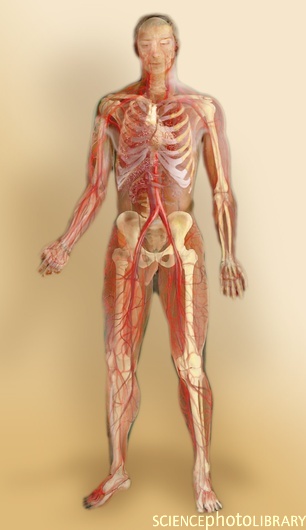
Immune system
This image shows the immune system. The immune system guards against invading organisms that may cause infection or disease. The the first line of defence is the skin and mucous membranes. The second line of defence is composed of white blood cells. White blood cells circulate around the blood system and destroy microorganisms that have penetrated the mechanical barriers of the body.
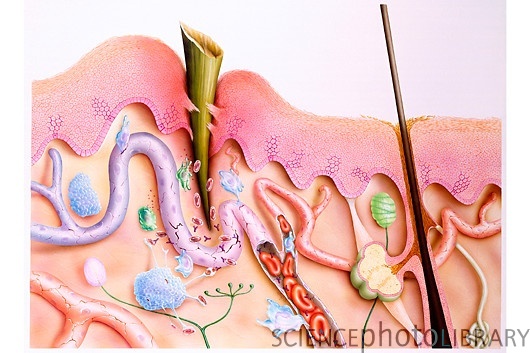
The immune system response
This image shows the immune system's response to a thorn (brown, centre left) that has pierced the skin. Bacteria (dark red) are ingested and destroyed by white blood cells (pale blue, lower left).

White blood cell
This is an electron micrograph of a type of white blood cell called a lymphocyte. Lymphocytes are divided into two main types of cell: T-cells or B-cells.
T-cells mature in the thymus and fight antigens by engulfing or swallowing them. NK-cells (natural killer cells) are a type of T-cell and seek out antigens and kill them.
B-cells mature in bone marrow and produce antibodies to destroy antigens. Antibodies stick to viruses and bacteria and slow them down. T-cells can then catch and destroy them.
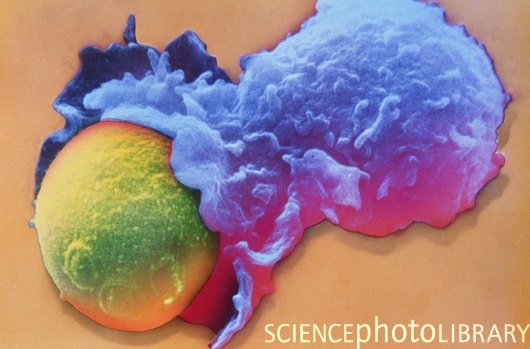
T-Cell
An electron micro-graph image of a T-cell (blue) destroying an antigen (green). The antigen is swallowed up and digested.
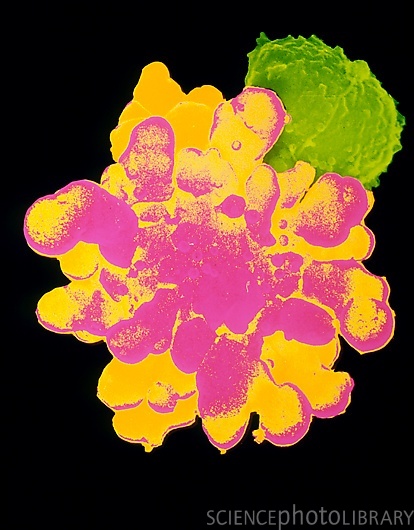
NK killer cell
An Electron micrograph image of a Natural Killer cell (green) attacking a large cancer tumour cell (pink & yellow).
This video from discovering psychology investigates the relationship between stress and the immune system. It looks at mind/body interactions and their relationships to disease and the immune system. Scroll down the screen and find video 4.
Video 4: Cognition and the immune system
Stress: On Line Films
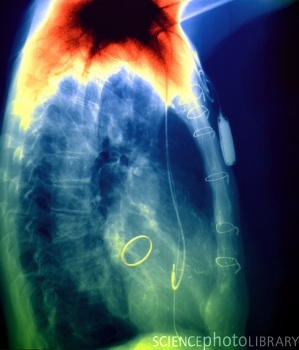
An image of an artificial heart valve and pacemaker.
The first link is to a website that provides a good overview of the biological approach. This is sometimes called Physiological Psychology. The stress unit focuses on this approach to investigating and explaining human behaviour.
Link to Discovering Psychology: Biological and Psychological approaches
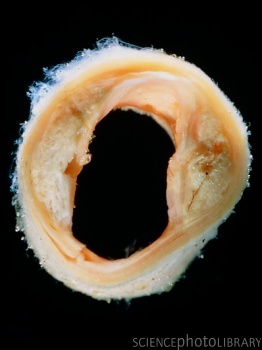
Image of a narrowed artery: atherosclerosis
The second link is to the discovering psychology website. This has loads of free on-line videos on all aspects of psychology. This video investigates the relationship between the mind and the body.
Scroll down the screen and find video 23.
Health, Mind, and Behavior
This program presents a rethinking of the relationship between mind and body. A new bio-psychosocial model is replacing the traditional biomedical model. With Dr. Judith Rodin of the University of Pennsylvania and Dr. Neal Miller of Yale University. Updated.
Link to Video 23: Health, Mind, and Behaviour

Image of the heart and its blood vessels
The third link is to a video that investigates the relationship between psychological factors and physical illness.
Scroll down the screen and find video 4.
Psychological Factors and Physical Illness
This program examines the relationship between emotions and health to explore how psychological treatment can improve well-being. It focuses on a teenager with migraine headaches, a dentist trying to decrease his risk for developing heart disease, and a woman with breast cancer, along with those who are treating them".
Link to Video 4: Psychological Factors and Physical Illness
Subscribe to:
Posts (Atom)


